Kaikki
November 10, 2025

How Generative AI Is Transforming Local Business Discovery — What Restaurants Must Know in 2026

AI isn’t just changing the rules for restaurants—it’s rewriting the whole playbook. In 2025, how people discover local businesses is evolving at warp speed. Search isn’t about ranking anymore—it’s about being understood by AI.
Ev charging stations
Published on
November 20, 2025
Key takeaways
  • AI discovery is about being understood, not just found.
  • Consistency, authenticity, and fresh data win.
  • Reviews and reputation now shape your visibility more than ever.
  • Automation (with Mobal) is your secret weapon.
  • The future belongs to restaurants who adapt—starting now.

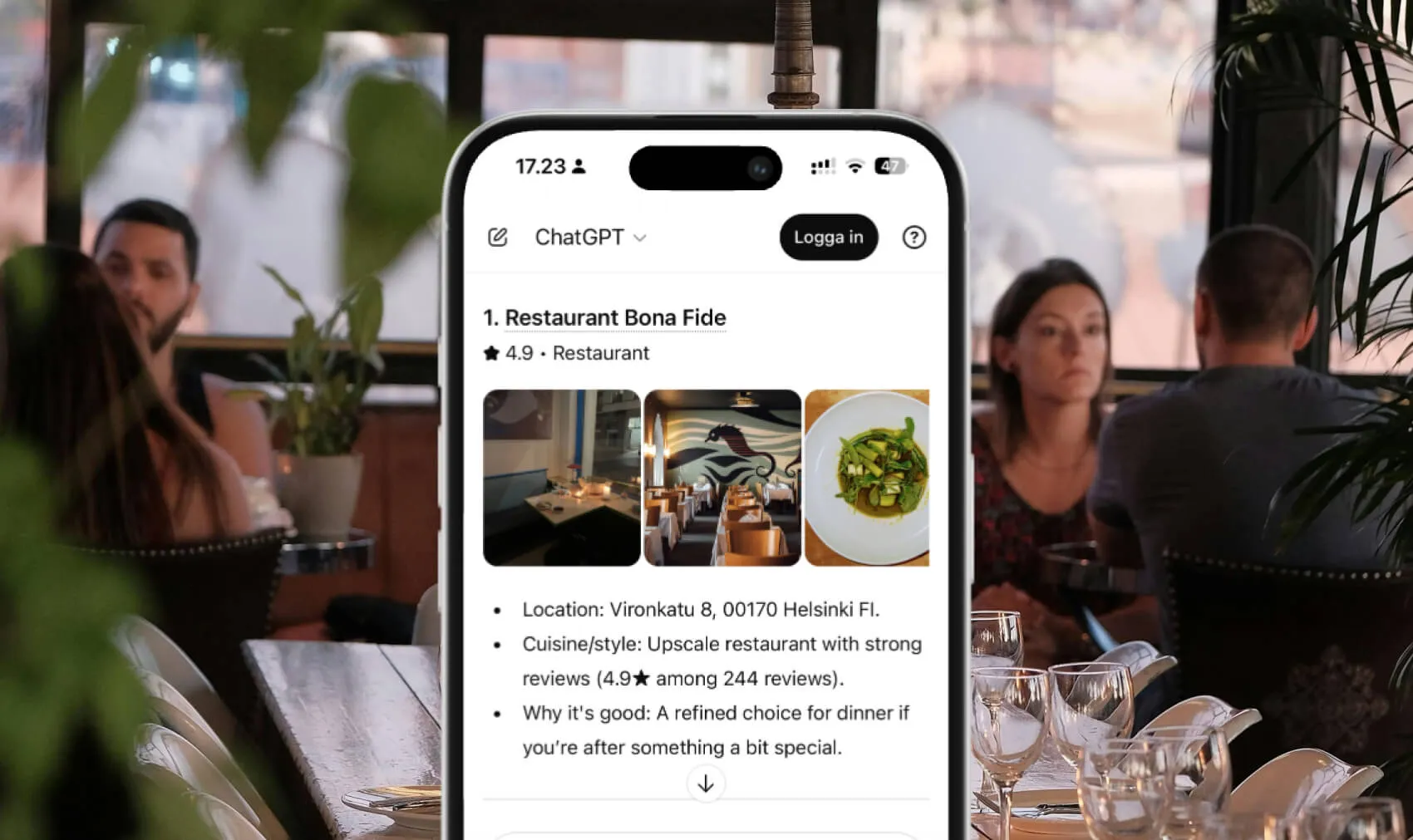
Generative AI is quietly reshaping how consumers find restaurants, shops, and services. Instead of scrolling through endless links, people now ask, “Where should I go for dinner tonight?”—and AI delivers a single, conversational answer. That answer decides who gets found, and who gets forgotten.

This isn’t just an SEO shift. It’s a paradigm shift in how visibility works.

From “Ranking” to “Understanding”: The New Era of Discovery

For years, local SEO was a tactical game: optimize your Google Business Profile, collect reviews, and target keywords like “best sushi in Helsinki.”

But generative AI has changed the rules.

AI systems like Google’s Search Generative Experience (SGE), ChatGPT, and Perplexity don’t just crawl data, they interpret it. They learn which businesses are relevant, trustworthy, and contextually aligned with a user’s intent.

When someone asks an AI,
“Find a cozy Italian restaurant nearby that’s open late and has great reviews,”
the system doesn’t return a list of websites. It synthesizes a personalized answer—often highlighting one or two local businesses that best fit the criteria.

The question for restaurants is no longer “How do we rank?” but “How do we get chosen?”

Why Generative AI Changes Everything for Local Businesses

Generative AI adds a layer of interpretation between your business and your potential customers. Instead of relying purely on proximity and keywords, discovery is now powered by meaning—the relationships between data points.

  • Your reviews aren’t just text; they’re analyzed for tone and themes (“fast service,” “romantic atmosphere,” “great wine list”).
  • Your photos and posts are scanned for visual and contextual relevance.
  • Your listing data is cross-verified for accuracy and freshness.
  • Your brand activity across the web (social media, websites, articles) builds a semantic profile of your business.

In other words, the AI doesn’t just read your business—it learns your business.

And it rewards those that are active, consistent, and easy to understand.

The New Ranking Factors in the Age of AI Search

Traditional SEO focused on keywords and backlinks. Generative AI discovery focuses on entities and relationships.

Here’s what matters now:

  • Entity clarity: Is your business recognized as a distinct “thing” across the web (consistent name, category, address, and data structure)?
  • Data freshness: Are your hours, menus, and offers regularly updated?
  • Reputation strength: Are your reviews genuine, recent, and sentiment-rich?
  • Structured content: Can AI easily read your website, schema, and product data?
  • Engagement signals: Do users interact with your content, posts, and listings?
  • Authenticity: Are your visuals and descriptions aligned with real-world experience?

Each of these factors feeds the AI’s ability to recommend your business with confidence.

What This Means for Restaurants

Restaurants live and die by discoverability.
In the generative AI era, that discoverability is shifting from search ranking to contextual selection.

Here’s what that means in practice:

  • Your menu and photos become key training data—AI uses them to understand what you serve and what the experience feels like.
  • Your reviews shape perception more deeply than ever—not just your star rating, but the language customers use.
  • Your digital consistency (hours, URLs, categories) builds trust—AI rewards businesses it can verify.
  • Your storytelling—the way you describe your brand, concept, and values—influences how AI summarizes you.

AI isn’t just ranking your restaurant; it’s representing your restaurant.

How to Adapt: A New Playbook for Local Discovery

To stay visible in the AI-driven search landscape, businesses must start thinking like data publishers, not just marketers.

1. Speak the Language of AI

Structure your digital footprint—use schema markup, update your Google Business Profile, and align your menu data across all platforms.
Mobal automates this, so you’re always up to date everywhere.

2. Build a Reputation Graph

Encourage authentic reviews that mention your specialties, atmosphere, and location.

Mobal’s dashboard lets you see and respond to every review, fast.

3. Publish Local Intelligence

Create content that answers real questions:
“Where to find the best pizza in Geneva?”
“What makes a great neighborhood café?”

Blog posts, local guides, and social content all strengthen your visibility footprint.

4. Automate the Routine

Use AI tools (like Mobal) to sync listings, manage reviews, and track how your business is interpreted online.

Automation ensures you stay fresh and consistent across dozens of discovery platforms.

5. Measure Visibility Beyond Clicks

Traditional SEO metrics (like web traffic) matter less. Instead, measure actions:

  • Map views
  • Directions requests
  • Review volume
  • Mentions in AI-generated answers
    This is the new local visibility scorecard.

Real Restaurant Example

A Helsinki sushi bar updates its menu and hours weekly, encourages detailed reviews, and posts daily specials on Instagram. Using Mobal, they sync updates across Google, Yelp, and TripAdvisor in one click. Result? They’re the top pick in AI-powered recommendations for “best sushi near me”—and their tables are full.

The Future: From Search Engines to Discovery Engines

We’re entering a world where AI intermediates every choice—from where we eat to what we buy.
As discovery becomes conversational, visibility depends on whether your business can be understood by AI models.

For restaurants, this means your presence must live not only on Google Maps but within the neural fabric of search itself.

The future isn’t about chasing algorithms. It’s about creating clarity, in your data, your reputation, and your story.

Ready to be chosen, not just found? Mobal helps restaurants stay visible, trusted, and top-of-mind in the age of AI search. Start today -> Watch your business grow.

Get started  today
Transform how you do business. Own your digital future.
Book a free demo
contact us today
White Arrow
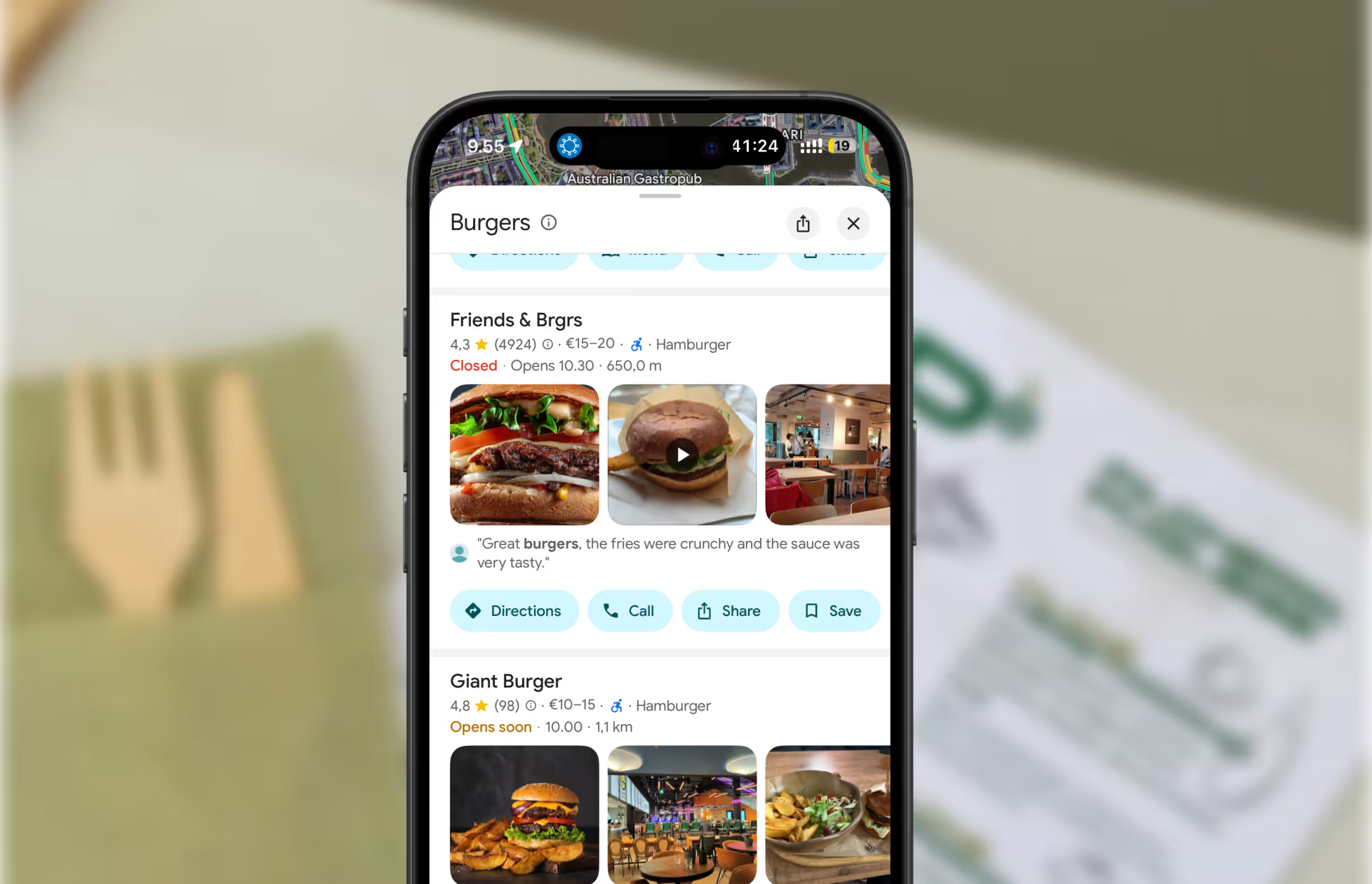
A screenshot of restaurants on Google Maps.
See how you stack up against your local competition
Discover how you stack up against nearby competition and uncover opportunities to win more customers.
Generate free report
Read about our privacy policy.
Thank you! Your submission has been received!
Oops! Something went wrong while submitting the form.

Related blog posts

No items found.
Join 8000+ businesses reaching more customers online with Mobal

Save time, reach more customers

Autamme yrityksiä menestymään verkossa

Varaa esittely
Icon
Icon
Middle-aged woman outdoors with a pink scarf draped over her shoulders and sunglasses on her head, smiling in a sunny park.
Three men wearing caps and jackets sitting and conversing on a boat with a foggy harbor in the background.Icon