

Apple Business Connecti integreerimise väljakuulutamine
Lisateave →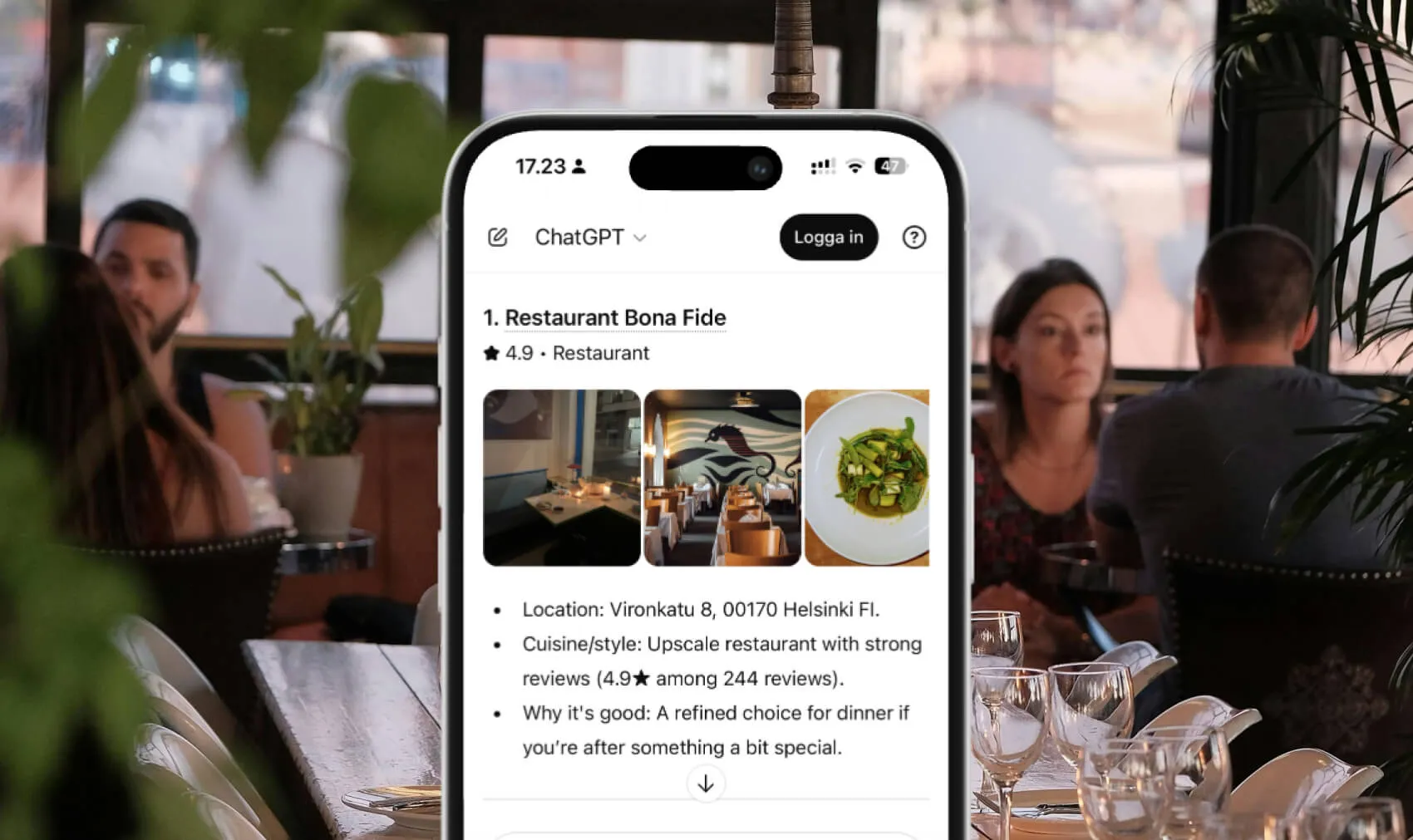
Generative AI is quietly reshaping how consumers find restaurants, shops, and services. Instead of scrolling through endless links, people now ask, “Where should I go for dinner tonight?”—and AI delivers a single, conversational answer. That answer decides who gets found, and who gets forgotten.
This isn’t just an SEO shift. It’s a paradigm shift in how visibility works.
For years, local SEO was a tactical game: optimize your Google Business Profile, collect reviews, and target keywords like “best sushi in Helsinki.”
But generative AI has changed the rules.
AI systems like Google’s Search Generative Experience (SGE), ChatGPT, and Perplexity don’t just crawl data, they interpret it. They learn which businesses are relevant, trustworthy, and contextually aligned with a user’s intent.
When someone asks an AI,
“Find a cozy Italian restaurant nearby that’s open late and has great reviews,”
the system doesn’t return a list of websites. It synthesizes a personalized answer—often highlighting one or two local businesses that best fit the criteria.
The question for restaurants is no longer “How do we rank?” but “How do we get chosen?”
Generative AI adds a layer of interpretation between your business and your potential customers. Instead of relying purely on proximity and keywords, discovery is now powered by meaning—the relationships between data points.
In other words, the AI doesn’t just read your business—it learns your business.
And it rewards those that are active, consistent, and easy to understand.
Traditional SEO focused on keywords and backlinks. Generative AI discovery focuses on entities and relationships.
Here’s what matters now:
Each of these factors feeds the AI’s ability to recommend your business with confidence.
Restaurants already trust Mobal to keep their listings accurate across Google and Apple. The website was the one part of their online presence still managed separately, with a different tool and a different login. Now it's part of the same system.
Every hour your site shows the wrong hours or an old menu is an hour a customer can be misled or turned away. And every evening spent editing a website is an evening away from the kitchen. Restaurant Websites removes both.
Customers can buy gift cards directly on the site and book a table through an added widget like TableOnline. An ordering button links out to your provider, such as Wolt. Your location details, menu, hours, and special hours stay in sync with your Google and Apple listings.
Choose from eight supported languages (English, Finnish, Swedish, Estonian, Russian, French, Spanish, and German) at launch and add translated versions of your site with a few clicks. More languages on request.
Restaurant Websites gives you a strong base built specifically for restaurants: the pages, layouts, and search foundations designed to help guests find and use your site. You can apply your own branding, colours, images, and pages on top.
Yes. You hand over your domain and keep it.
€29 per website per month, as an add-on. You can build and preview a site free in the demo before committing.

.webp)
.avif)



.webp)

.svg)
